

This week I attended a webinar on disinformation in Sudan, a topic that does not receive a lot of mainstream attention in the United States. I thought I’d use my newsletter, then, to share what I learned and connect it to broader dynamics playing out in social media, A.I., and information warfare.
First, it bears stressing that the work on disinformation in Sudan is not my own. I was impressed with the activists and scholars who presented it, and part of my goal is to amplify their efforts using my platform. The speakers included:
Marwa Fatafta, a policy analyst at Access Now;
Eilaf Mohamed, a research fellow at the African Middle East Leadership Project;
Hussam Abualfata, a Sudanese political activist; and,
Amgad Abdelgadir, a London-based journalist with Radio Dabanga.
Please follow them on social media and read their materials.
Sudan is not a subject I have devoted much attention to in my career. It is a hugely complex country (now two countries), the history of which I will only briefly summarize.
Any understanding of Sudan is intermingled with its neighbor to the north, Egypt, with whom it has a long, interconnected past that dates back thousands of years. At the heart has been the Nile River, which served in ancient times as a vital trade route for Egyptian grain going south and Sudanese gold, ivory, and carnelian going north. Also going north were slaves, as the Egyptians captured indigenous tribal members and enslaved them as servants, concubines and soldiers. The specter of Egyptian enslavement still informs Sudanese-Egyptian relations today.
As is the case with much African territory, the country we know as Sudan was battled for and contested throughout the centuries by Egyptians, Romans, Kushites, Byzantines and others. Arguably the most consequential event was the arrival of Islam, which gradually cleaved Sudan into two halves: a northern half that adhered to Islam and a southern half that adhered to a variety of indigenous animist religions. A pattern formed of a northern half trying to impose Islam on the southern half, a dynamic that lasted for approximately 700 years and ultimately, along with other factors, led to a split into two countries: Sudan and South Sudan.
Imperialism also played a role: in the 19th century, the Egyptians returned in coordination with the British and subjugated Sudan into an Anglo-Egyptian colony. The Suez Canal had opened in 1869, and to protect its economic pathway to India and the Far East, the British became heavily in invested the Red Sea, along which Sudan has more than 500 miles of coastland. The British, with help from Egyptian, Indian, and south Sudanese forces, suppressed a violent Islamic jihad movement and established an Anglo-Egyptian Condominium under British rule, which lasted from 1899-1955. As part of their rule, the British abolished slavery, which had continued under Arab Muslims in the north.
The Second World War and the decolonization movements it empowered arrived in Sudan following the war, and by 1956 Sudan had declared independence. The subsequent decades, however, were defined by military rule, a series of coups, ethnic and tribal conflict and continued animosity between north and south. Two decades of civil war ended in 2005, setting up a referendum six years later wherein voters in the south overwhelmingly chose to secede and create South Sudan, which became its own country in 2011. However, independence did not remove long-held tensions. Within a couple of years, South Sudan descended into civil war along ethnic and religious lines vying for political power. Today’s fighting is an extension of failed attempts to create a unity government, disarm militias, find harmony among various ethnicities, and hold elections. The current president of South Sudan, Salva Kiir, a Roman Catholic from the Dinka tribe, is a former rebel commander who fought for South Sudanese independence as part of the Sudan People’s Liberation Army/Movement. He became South Sudan’s president in 2011; elections have not occurred since.
If this backdrop sounds exceedingly complicated, it is. Sudan is large and incredibly diverse, making it highly complex to unify into one—or two—countries. Prior to secession, Sudan was the largest country in Africa and the tenth largest in the world, at nearly 1 million square miles. It contained more than 400 languages and comprised roughly 600 ethnicities. The north had large Muslim populations where Sharia law existed, there were also Christians (Catholics, Presbyterians, Coptics) and indigenous African religions, which predominated in the south. Southern distrust of the north was long-in-the-making due to the legacies of Islamic/Arab enslavement and the imposition of Sharia law, most recently by the dictatorial al-Bashir regime.
Sudan also has oil, which was discovered in the 1970s and has been a source of revenue and conflict. Even today, Sudan and South Sudan continue to fight over oil revenue and oil pipelines. The region also has abundant natural gas and minerals (including gold and asbestos), which also contribute to fighting as factions vie for access and control. (Some of the violence between Muslim militias and tribal groups have been over the control of gold mines). Finally, Sudan and South Sudan are still contesting who owns the regions near their border, as well as the fates of southerners who lived in the north and northerners who lived in the south.
Within this morass of messy history, warfare has raged on the ground and online, with all sides attempting to suppress, distort and manipulate information in order to advance their objectives. The research presented during the webinar divided the information manipulation into four categories:
Internet shutdowns
Attacks on journalists
Crafting narratives and flooding the zone
Using A.I. to obfuscate and confuse
Internet shutdowns
Internet shutdowns are unfortunately a common tactic of governments to stifle dissent and opposition. Readers will be familiar with Iran, which cut off Internet access among its people as it violently suppressed protests in recent weeks. When one looks across the globe, one can find evidence of Internet and cell service shutdowns by governments in nearly every corner of the world: Myanmar, Russia, India, Pakistan, Kenya, Mauritius, Mozambique, Bangladesh, Iraq, El Salvador, Jordan and more. Sometimes restricted access to Web and cell service lasts for a few days; other times it can last for weeks or months. France, for example, blocked access to TikTok in its colony of New Caledonia for several days in 2024, accusing the app of being complicit in organizing violent protests against its rule.
Such government actions—which run counter to the United Nations commitment to freedom of opinion and expression—purposefully restrict access to information during times of crisis as a means of social control. The justification is always framed in language of an “emergency” or “national security,” but the intention is to suppress speech, quell opposition and compel public opinion. In Sudan, the Sudanese Armed Forces cut off Internet access in the Darfur region in 2024. In retaliation, the Rapid Support Forces—a paramilitary force formed from prior militias and comprised largely of Arabic-speakers—seized control of data centers in Sudan’s capital, sabotaging equipment and causing widespread internet outages.
The practical effects have been that it remains extremely difficult for Sudanese civilians to find information they need to navigate the violent civil war. Sudan has an estimated 25 million people who require humanitarian assistance, with an estimated 18 million people facing acute hunger. Lack of Internet access blocks individuals from knowing where to find food, where aid distribution centers are located, how and when to evacuate an area ahead of fighting, or how to access basic goods and services. Into that information void steps the military and the militias, who dictate what information gets delivered.
Attacks on journalists
Another method of dictating what information gets delivered is to attack and intimidate the journalists who report on the conflict. This will be another familiar tactic to readers around the world, as attacks on journalists have become all-too-common by governments seeking to control what information their citizens know. The homepage of the Committee to Protect Journalists identifies 129 journalists and media workers killed in 2025, with 329 imprisoned and 84 individuals missing.
Sudan has witnessed many attacks on journalists. The researchers stated that over 90 percent of Sudan’s local media outlets have stopped functioning. Newsrooms have been shattered and journalists have been threatened. One panelist showed a photograph of a studio from the Article Centre for Training and Media Production in Khartoum, Sudan’s capital, which was completely destroyed during military operations. Journalists who remained in Sudan to document the massacre by the Rapid Support Forces in Darfur have reported their colleagues being killed, detained, tortured and threatened. In one instance, a surviving journalist was captured, beaten, stripped of his belongings and forced to walk five days across the desert without food or water in order to reach safety.
The result has been an increased difficulty of Sudanese citizens, and the world at-large, to understand the true extent of the carnage. Images and reporting have trickled out, but much of the information about the conflict remains opaque. One antidote has been the use of short-wave radio; using radio waves that reflect off the ions in the Earth’s atmosphere, Radio Dabanga can transmit short-wave signals in Sudanese Arabic that reach remote areas besieged by conflict, independent of satellites, the printed press and the World Wide Web.
Crafting narratives
When journalists are silenced and the internet is restricted, it creates an information vacuum. Into that vacuum steps those who wish to shape the narrative and dictate what people understand about current events. Such propaganda has the express purpose of swaying public opinion to sympathize with one side over another, and to believe a particular version of events regardless of how biased they may be.
The panelists highlighted several narratives used in the Sudan conflict to sway public opinion. One tactic is to frame the other side as an existential threat. Such a narrative justifies the use of lethal force—including against unarmed civilians, women and children. If the opposing side is an existential threat to the existence and survival of your country, then violence by any means becomes a justified response to eradicate such a threat. Readers will find this concept familiar; variations of it have been used in genocides throughout the 20th and 21st centuries to justify ethnic cleansing and unspeakable crimes, including during the Holocaust, where European Jews were framed as an existential threat to German society, leading to horrific violence. In Sudan, content on social media is crafted to advance a similar narrative, distributed across social media channels, particularly messaging apps such as WhatsApp, Telegram, Signal, Botim and Viber. (The Sudanese government blocked access to WhatsApp under the pretense of “national security” but many Sudanese have found ways to circumvent the ban.)
Another technique has been to downplay incidents and shift blame to victims. It has been concluded by the United Nations that the RSF Arab paramilitary forces committed a genocidal massacre in the city of El-Fasher, going door to door and murdering non-Arab civilians. The response from the RSF has been to downplay the incident and blame the victims for the crime. Readers may also find such a tactic familiar. It is drawn from a playback of skirting responsibility and blaming victims that stretches from Moscow to Minneapolis.
Using A.I. to obfuscate
The final tactic discussed was the introduction of A.I.-generated content into this already complex ecosystem. While the amount of A.I.-generated content remains relatively low, it has been having an effect. According to a report released by the African Middle East Leadership Project, voice cloning using A.I. has been used to simulate the voice of Sudan’s former president as well as commanders discussing alleged plans to murder civilians. These A.I. forgeries have circulated on platforms such as TikTok and Twitter / X. Supporters of the Sudanese Army also generated a conspiracy using A.I. that the leader of the Rapid Support Forces was dead and his entire life had been fake and A.I.-generated. Polling suggested that even after seeing a video of him alive, nearly half of respondents were not sure it was real.
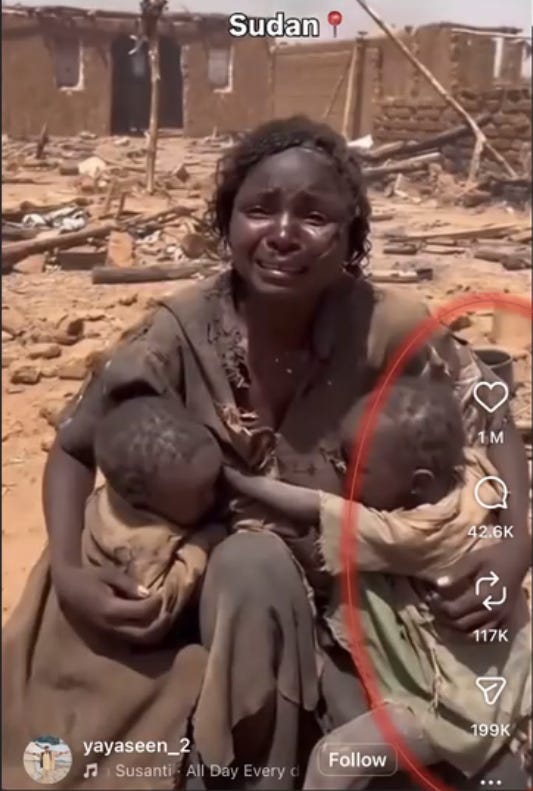
Content creators have also used A.I. to fabricate images of suffering from Sudan that are not real. The A.I.-generated image depicted at the top of this article received more than 1 million likes on Instagram. Other content creators have taken war footage from other conflicts and claimed it was from Sudan. (This has also been done for Gaza and Ukraine, where images and videos from prior conflicts are edited and re-used claiming to be from current ones). The rationales for such manipulations are usually to boost follower counts and views. When topics are trending online, particularly newsworthy topics with vivid imagery that capture world attention, opportunists will claim to be showing emotional or gut-wrenching scenes in order to draw more attention to their accounts, boost their followers, and gain influence.
The sum effects of these A.I. manipulations remain an open question. The researcher on the webinar suggested that one current effect has been to make information consumers skeptical of all information. In a world where anything can be A.I.-generated, nothing is believable. Another effect, she said, has been to recognize that what we choose to believe relies on our preconceived notions. In other words, we don’t distrust information because it is A.I.; we distrust it because it does not align with our previously held convictions, regardless of whether it is A.I.-generated or not.
What was most striking about the webinar was how the dynamics described were so recognizable. As stated at the outset, devastating as the war in Sudan has been, it has not been a huge area of focus for my own work. Yet, as the researchers presented their evidence, it all felt entirely familiar. Attacks on journalists, cutting off access to Internet or social media platforms, crafting propagandistic narratives, and A.I. generated material that blurs the lines between reality and fiction—these are themes that should be familiar to us all. Regardless of where we live and what world events capture our attention, these dynamics are present. They have become ubiquitous in 21st century warfare, and they have also become tools that governments and paramilitary forces use to wield power, suppress dissent, and erode basic freedoms. The playbooks are universal, adapted to specific circumstances and local conditions.
What is happening in Sudan carries lessons for all of us—lessons we should hold closely if-and-when these dynamics, inevitably, begin to appear in our own countries.
Have an informed week,
-JS
It’s sadly and shamefully true that the victims of one place and time can and sometimes do become the victimizers of another place and time. And this is much easier for a conscience to allow when the victimized are essentially seen as an innately much lower lifeform who also look different from you.
We saw this with Israel's decades-long abuse of Palestinians, and we’re especially seeing this with the atrocities happening in Palestine now.
Even outside of the Middle East, many human beings are perceived and treated as though they are literally disposable and, by extension, their great suffering and numerous deaths are somehow less worthy of external concern, sometimes even by otherwise democratic, relatively civilized and supposedly Christian nations.
A somewhat similar reprehensible inhuman(e) devaluation is observable in external attitudes, albeit perhaps on a subconscious level, toward the daily civilian lives lost in prolongedly devastating warzones and famine-stricken regions. In other words, the worth of such life will be measured by its overabundance and/or the protracted conditions under which it suffers; and those people can eventually receive meagre column inches on the back page of the First World’s daily news.
It clearly is an immoral consideration of ‘quality’ of life or people.
With each news report of immense yet unnecessary/preventable daily sufferings and civilian death tolls internationally, I (though a big fan of Christ’s miracles and messages) can feel a slightly greater desensitization and resignation. I’ve noticed this disturbing effect with basically all major protracted conflicts/famines globally since I began regularly consuming news products in the late 1980s.
ALSO, people should avoid believing, let alone claiming, that they are not capable of committing an atrocity, even if relentlessly pushed. Contrary to what is claimed or felt by many of us, deep down there’s a potential monster in each of us that, under the just-right circumstances, can be unleashed — and maybe even more so when convinced that ‘God is on our side’.
But all lives and needless suffering should matter to us all. However, that’s easier for a conscience to dismiss when one considers another an innately much lower lifeform.
Very informative and thought-provoking. We also understand that the war is unbelievably brutal. So sad.